
GEO Services

Search is moving from ten blue links to a single generated answer. GEO is the work that makes an AI choose to cite you instead of someone else.

Since 2018Websites and search visibility
TrilingualTraditional / Simplified / English
Item-by-item schemaStructured data validated page by page

What does our GEO service include?

We deliver end-to-end generative engine optimisation: AI visibility diagnosis, content restructuring, brand entity and authority signals, plus citation monitoring and measurement. You receive content structures that large language models can crawl and quote, a consistent definition of your brand entity, and ongoing reports on AI mentions and citations, so your brand actually appears inside generated answers.

Last updated: October 2026 · Maintained by the Jionghui editorial team

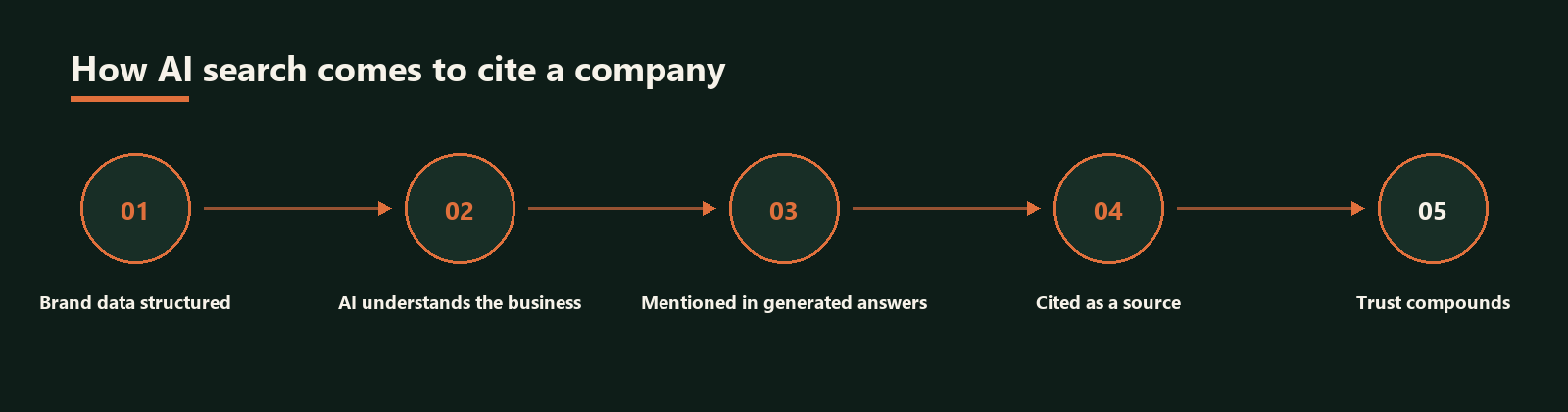
GEO Services — service diagram

What is GEO?

GEO stands for Generative Engine Optimization. It is not about repeating the same keyword across a page. It is about making it easy for search systems to recognise who your brand is, which services you provide, who those services are for, and which parts of your content can be used as an answer source. The work builds on a crawlable website, accurate brand facts and verifiable content, using clear headings, direct answers, entity relationships and consistent citations to reduce ambiguity.

Classic search results ask the user to choose between links. Generative search may summarise several sources before answering. If a corporate site contains only marketing slogans, with no clear definitions, process, limitations or frequently asked questions, a system has little to extract. GEO therefore asks whether each core page can answer one real question on its own.

How is GEO different from SEO?

Aspect SEO GEO
Main goal Rankings and organic traffic Visibility in AI search
Main entry points Google / Bing AI search and generative answers
Keywords Important Still important, not the only factor
Entities Important More important
Schema Helpful Helps machines understand
Content Search demand Answer-first, quotable content
Metrics Impressions / clicks Mentions / citations / referrals

The two share a large amount of foundation work. A site still has to be indexable, reasonably fast, stable in its URLs and trustworthy in its content before entity and answer work is layered on top. Start with our Hong Kong SEO service to see which gap matters most right now.

Why does a business need GEO?

While researching suppliers, a prospective client may first ask ChatGPT, Gemini, Copilot or Perplexity about the type of vendor they need, how packages differ, or which risks to watch for. If your company name, service names and contact details are inconsistent across the site, or if the important answers are scattered over many pages, a system cannot build reliable connections. GEO organises the most important brand and service facts first, so that the site tells the same story wherever it is discovered.

The work suits companies that already have a site and some SEO foundation but whose service pages still read like brochures. It also suits teams planning a new build, where content and entities can be planned alongside Hong Kong web development instead of being retrofitted later.

What does GEO work include?

The first phase usually covers a GEO audit of the site, Organisation and Service entity clean-up, a review of schema relationships, answer-first content, FAQ blocks, brand consistency and the internal links that are needed. It also checks whether each page states who the service is for, which problem it solves, how it is delivered and what its limits are, and whether structured data matches the text a visitor actually sees.

On WordPress sites we keep the existing theme and SEO configuration rather than duplicating output or editing core files. New material goes into service pages you can maintain, not into a large volume of near-duplicate posts. See our WordPress development service for how the site is managed day to day.

How do we run a GEO project?

We start by agreeing which brands, services and questions matter most, then examine how the site currently expresses those facts. Fixes are then applied in order of impact: entity recognition, service relationships, direct answers on the page and FAQ content, while preserving the URLs and content that already work. Before handover we check desktop and mobile rendering, language tags, canonicals, schema and internal links to make sure nothing has broken the existing search foundation.

GEO should never be built on invented reviews, numbers or features. Addresses, awards, prices and client counts that cannot be confirmed from the website or from company records are not written into pages or schema. Public descriptions also distinguish clearly between what is delivered today and what is only planned.

How is GEO measured?

For now a simple baseline works best: record whether the brand and its priority services are understood, mentioned or cited for a fixed set of questions, watch the referral traffic that arrives from AI platforms, and read it alongside Search Console impressions, clicks and landing page performance. Compare the same questions over the same intervals rather than reacting to a single volatile answer.

No method can guarantee that a generative platform will recommend a particular website. A realistic goal is to keep raising the chance that your content is understood correctly, discovered, mentioned and cited, while keeping verifiable sources and a clear path to make an enquiry.

01 / Modules

Four modules of GEO work

The work covers how content is phrased, how the site is structured and how brand facts are recorded, scoped to what your website actually needs.

01

Site GEO audit

Review how existing brand, service and priority questions are expressed, and set a baseline to improve against.

02

Content structuring

Add direct answers, heading hierarchy and FAQ blocks so the important material is easy to read and quote.

03

Brand entity clean-up

Align brand name, service scope and page relationships so pages stop contradicting each other.

04

SEO and GEO together

Build on the search foundation you already have, and fold content and structure work into a maintainable process.

02 / What is included

Included in every GEO engagement

Same principle as our web development work: these are delivery standards, not paid add-ons.

  • Baseline report across major AI engines
  • Target prompt set design
  • Answer-first rewriting and paragraph restructuring of existing content
  • Review of AI crawler access policy
  • Structured data completion
  • Brand entity consistency check
  • Audit of external authoritative mentions with source suggestions
  • AI crawler log analysis
  • Shared content assets with SEO
  • Monthly visibility report and optimisation list

03 / Delivery process

How a GEO project runs

Confirm the facts and the priority questions first, then adjust step by step and check the result.

Baseline diagnosis

Test how major AI engines currently answer questions about your brand and core services.

Topic planning

Define the target prompt set and topic clusters in order of business priority.

Content structuring

Add direct answer blocks, Q&A structure and verifiable statements of fact.

Technical and entity setup

Complete structured data and unify brand entity information.

Monitoring and validation

Re-test the same prompt set regularly and compare citations and mentions.

Iteration

Adjust content and external mention strategy based on what the monitoring shows.

04 / Ways to work together

How can we work together?

GEO audit

We first test how major AI engines currently describe your brand and core services, then list what to fix first — before rewriting anything.

GEO plus SEO

Generative engine optimisation planned together with the Google SEO you already run, sharing keyword and content assets instead of telling two separate stories.

GEO partnership

Quarterly strengthening of structured data and answer-led content. Suits teams investing in stages who need the effect to compound.

05 / Why Jionghui

Four things to check in a service provider

01

Entity before content

We align brand name, service scope and page relationships first. An AI needs a citable entity before content can be attributed to it correctly.

02

Schema on every page

Not just the homepage: service pages and articles get the structured data type that fits them, validated item by item.

03

Answer-first writing

Each topic opens with a direct answer before the explanation, which is how generative engines actually extract material.

04

Changes you can verify

We track indexing, citations and mentions, review them quarterly, and avoid vague promises.

06 / Service comparison

Our GEO service versus SEO alone

Jionghui GEOSEO only
Optimising forCitations and mentions in generated answersRankings and clicks on the results page
Content formatAnswer blocks, Q&A structure, verifiable factsKeyword coverage and length
Brand entityDefined clearly and consistent across the siteUsually not handled systematically
Structured dataCompleted site-wide and validated item by itemMostly basic homepage markup
MeasurementAI mention rate, citation count and sourcesRankings, impressions and clicks
How they relateShares content assets with SEO and compoundsRuns separately from AI search

07 / FAQ

Frequently asked questions

How is GEO different from SEO?
GEO targets citations and mentions inside generated answers; SEO targets rankings and clicks on the results page. They share content and technical foundations, but GEO puts more weight on answer structure, verifiable facts and brand entity consistency.
How long until we see change?
Technical and structured data changes are usually re-crawled within two to four weeks. AI citations and mentions typically need six to twelve weeks of consistent work and content accumulation before a stable trend appears.
Do we need a lot of new content?
Not necessarily. The first phase usually restructures what already exists; new articles are written only for the gaps the audit identifies, which keeps costs down.
Is GEO suitable for my industry?
It applies wherever customers ask AI for recommendations, especially professional services and B2B with longer decision cycles.
Will GEO and SEO be billed twice?
No. Both services share the keyword and content asset review, and work already completed is not charged again.

Want your brand inside the answers?

Book an AI visibility audit. We will show how your brand is currently described by major AI engines, which issues to fix first, and a practical improvement list.

Book an AI visibility audit